

⭐ FEATURED SPONSOR: AI Create Agency

Know a parent who runs a business and still has no website? Holiday customers are searching right now. AI Create Agency builds mobile-ready sites for local trades and small businesses: your services, real photos, and click-to-call. Founding Starter is $249 setup + $49/mo for our first 10 clients. It includes a mobile-ready trade website, monthly care, and a Preferred Listing on 714beat.com. Custom builds and upgrades: Contact us for pricing.
Get a free site check → Featured sponsor: AI Create Agency, our own company.

OC weekend pulse → read 714 Beat
👋 Happy Friday, Nov 20.
This week, a consumer watchdog tested seven AI toys and found some would discuss sexual topics or tell a tester where to find dangerous items at home. A lawsuit filed this month alleges a 13-year-old reached Google’s Gemini through Search on her school Chromebook, even after the school blocked the Gemini site. And New Jersey’s governor’s office says Google is trying to “strongarm” schools into classroom AI.
This issue’s angle: the AI in holiday toys and school search is not always obvious, and it is not always blocked when you think it is. So test any talking toy yourself before it gets wrapped, and get a straight answer from your school on what its filters and alerts really cover.
Prefer to listen? The full episode (13:13) is in the player at the top of this post, or listen at media.aidad.co.
Let’s dive in.

🚀 THIS WEEK’S AI STORY SUMMARIES
A) Watchdogs tested 7 AI toys. Two shared sexual content, and two listen to everything when on On Nov 17, U.S. PIRG Education Fund published “Trouble in Toyland 2026,” its second year of testing chatbot-enabled toys. “We tested seven toys on the market. Like last year, we found some had glitchy guardrails that allowed them to discuss sexual topics, while others gave instructions on finding potentially dangerous objects in the home and how to light a match.” In a summary of those tests, PIRG said: “Two provided sexually explicit information and told us where to find dangerous items in the home.” “Two listen to everything if they’re on.” “One took photos of us unexpectedly.” PIRG also said “Many of the toys we tested appear to use chatbots that are designed for adults, such as ChatGPT,” and that “One toy we tested introduced a new $5 monthly subscription to use the AI chatbot which had previously been free.” It was not all bad news: “some of the toys we tested last year had improved, including one that isn’t as clingy as it was last year.”
The same day, NBC News reported that the Contixo AI Pixie-Paw, a plush cat marketed to children as young as 3, described sexual violence, and that “Three major retailers are pulling it.” NBC said the toy promises “storytelling, learning & safe roleplay,” according to its Amazon description, and that “NBC News tested three AI toys that it purchased from Amazon.” We are citing only NBC’s published headline, subheadline, page title, and first paragraph. The rest of the article is paywalled, and we have not independently confirmed which retailers are involved.
👉 Why it matters: If a talking plush is on your gift list, it may be running an adult chatbot under the fur. Test it yourself before you wrap it (see this issue’s tip and Tool Picks).
Sources: pirg.org · publicinterestnetwork.org · nbcnews.com
B) Lawsuit: a 13-year-old reached Gemini through Google Search on her school Chromebook A lawsuit filed Nov 2 in Santa Clara County Superior Court, according to Google’s notice of removal, and announced Nov 4 by the EdTech Law Center and Qureshi Law, alleges that a 13-year-old, proceeding under the pseudonym Emma Doe, reached Google’s Gemini through AI Mode in Search on her school-issued Chromebook. These are allegations. Nothing has been decided. In its notice of removal to federal court, Google said “Google and Alphabet deny the Complaint’s allegations.”
The EdTech Law Center’s case page says Emma “began heavily using Google’s Gemini-powered AI Mode on her school-issued Chromebook in December 2025.” It says she “never sought out Gemini,” that it “just showed up in Google search one day,” and that “by March 2026, she was exchanging thousands of messages a month.”
WIRED, in a Nov 11 report, said: “Though Emma’s school had blocked the stand-alone Gemini website, the lawsuit alleges that she was steered into interacting with the chatbot through AI Mode.” WIRED reported that the family’s lawyer, Andrew Liddell, said that, according to information the school provided to the family, “the alert went to the personal phone of a former counselor who had left the school nine months before.” Liddell told WIRED the former employee passed the alert along to current staff, who then notified the girl’s mother.
A Google spokesperson, José Castañeda, told WIRED the company is seriously “reviewing the claims in the lawsuit” and that its systems, including AI Mode, “aim to prevent users from engaging in harmful conversation.”
👉 Why it matters: Blocking the Gemini website did not, according to this lawsuit, block Gemini. Ask your school what its filters actually cover, and who gets the alerts (see Tool Picks).
Sources: edtech.law · business.cch.com · wired.com
C) Follow-up to #30 and #31: New Jersey’s governor pushes back on Google’s school AI and Search choice In #30 and #31 we covered Google’s plan to make schools choose AI features if they want to keep Search for K-12 student accounts. The news this week is a sitting governor objecting in public. On Nov 16, NJ.com reported that “Gov. Mikie Sherrill’s office is blasting Google for trying to ‘strongarm’ New Jersey schools into using artificial intelligence in the classroom.” A spokesperson said: “Google’s decision to strongarm school districts into exposing young learners to AI by threatening to cut off access to its search engine undermines that ability and puts corporate interests ahead of our kids.” The spokesperson added: “We must have the ability to make local decisions about student well-being, online safety, and healthy technology use.” NJ.com reported that “The company is not offering an AI-free search option to schools,” and that Google “did not immediately respond to an NJ.com request for comment on its new policy.” NJ.com also quoted a Nov 3 Google social media post: “We know there’s concern about students using AI to shortcut schoolwork, and schools have told us they want control. That’s exactly why we are making these changes today to address the feedback we’ve heard from educators in recent months.”
👉 Why it matters: If your district has not said which way it is leaning on Google’s AI and Search choice, this is a good week to ask, and to ask whether blocking Gemini also covers AI Mode in Search.
Sources: nj.com · blog.google
D) Roanoke County makes a “no-AI zone” the student default, and students push back on Copyleaks WFIR News reported on Nov 16 that the Roanoke County school board formally adopted Policy 6.42c on Thursday, Nov 12, “codifying rules around artificial intelligence alongside the division’s existing three-zone learning framework to prevent ‘cognitive offloading’ by students.” “District guidelines allow teachers to use AI for routine tasks such as lesson planning and administrative work, while students default to a no-AI zone for most assignments.” Student representative Addy Weaver also raised concerns about Copyleaks, “the AI plagiarism checker in Canvas.” As WFIR quoted Weaver: “its performance has been largely ineffective and students accused of using AI have few ways to disprove the claim within Copyleaks’ current system.”
👉 Why it matters: If your kid gets flagged by an AI detector, ask what evidence backs it, and whether the school has a clear way to appeal (see Tool Picks).
Source: wfirnews.com
E) Quick hit: 56% of K-12 parents in a new survey want AI fully blocked in schools A Nov 12 Institute for Family Studies brief, based on a YouGov survey of 2,000 American parents ages 25 to 70 whose children range from 5 to 18, fielded July 27 to August 13, 2026 (margin of error +/- 2.6%), found: “A majority (56%) of parents want AI fully blocked in schools, and another 26% want less AI in schools than is currently required or allowed. Only 13% of parents want more AI use in school, and a mere 6% want as much AI use as possible.” The same brief found that “77% say that AI will undermine learning, 79% say that AI will enable malicious behavior by students, and 73% say it will expose children to serious risks.”
👉 Why it matters: If your school is writing AI rules this year, you are not the only parent asking how much AI belongs in class, or whether it belongs there at all.
Source: ifstudies.org
F) Quick hit: Kansas AG, in a status update, says the state’s OpenAI suit alleges ChatGPT “coached a minor to suicide” On Nov 16, KWCH reported that Kansas Attorney General Kris Kobach told lawmakers the state’s OpenAI lawsuit alleges the chatbot gave minors dangerous advice. “In one case, coached a minor to suicide,” Kobach said. These are allegations in an ongoing case. We covered the broader multi-state OpenAI suits in earlier issues.
Source: kwch.com
G) Quick hit: a Northwell summary says about 1 in 5 Ontario students have used AI for feelings According to an article from The Well by Northwell, dated Nov 9, researchers surveyed 39,761 students in Ontario, Canada, with an average age of about 13, and “About 21% of students said they had” used an AI chatbot to help with their feelings or to get advice on dealing with friends, parents, or other people. We have not reviewed the underlying journal paper, so this figure comes only from Northwell’s summary. The article includes this caveat, quoting Dr. Consuelo Cagande: “The study can’t tell us whether AI contributed to their distress or whether kids who were already struggling were simply more likely to turn to it.”
Source: thewell.northwell.edu
💙 Several stories in this issue touch on self-harm and kids’ mental health. If you or someone you know is struggling or in crisis, call or text 988 or chat at 988lifeline.org (Suicide & Crisis Lifeline, U.S.), any time.
A couple of deals worth a look
Dell laptop deals (prices checked Nov 17) Dell’s laptop deals page says “Shop Laptop Deals Up To $400 Off.” An XPS 13 Laptop is listed at a Dell Price of $749.99. Dell also says “Dell Rewards Members Get First Access to Our Best Black Friday Deals. Savings shown in Cart.” Its separate Black Friday page still says “Black Friday Deals are coming soon” and “Black Friday Deals arriving this November.” Prices can change, so check the live page before you buy. Shop: dell.com · dell.com
Wispr Flow Wispr Flow is a dictation app. Its pricing page says it is “Free on Mac, Windows, iPhone and Android.” Pro is listed at $15 per user per month, with an annual 20% discount. We did not find a current promo. The newest release note on its what’s-new page was still dated October 30, 2026. Try it: wisprflow.ai
🛠️ CLICKABLE TOOL PICKS
PIRG’s AI-toy checklist, before you buy and once it’s home (tie-in to story A)
What it does: U.S. PIRG Education Fund’s Trouble in Toyland 2026 report includes “A.I. TOY TIPS FOR PARENTS.” The tips cover how the toy listens, what data it collects, and how to test it.
Why it matters: A talking toy can keep listening, collect data, or slip into adult topics. PIRG’s own tests are the reason to slow down before you wrap one.
Try it:
Look at “whether the company is transparent about which chatbot it’s using and what guardrails it’s put in place to make sure the toy will stick to kid-appropriate topics.”
Prefer a physical push-to-talk control. PIRG says: “The safest way to ensure the toy is not listening when it shouldn’t is buying a toy with a physical component to begin recording, like a push-to-talk button you have to physically hold down for the duration of recording, similar to a walkie talkie.”
In the privacy policy, “Ctrl + f for the word ‘data’ and ‘personal information’ to find the list.” “Any mention of advertisers receiving your child’s data is a big red flag.”
Test it yourself. “Testing for 15 minutes isn’t enough to really get a sense; at least an hour is best, if you can find the time.”
“We recommend a child use the toy in shared spaces, not their bedroom or bathroom.”
Turn it all the way off. “Saying ‘goodbye’ may seem like enough to your child, but will trigger toys to go into sleep mode instead of turning completely off.”
Check parental controls, including: “Can you turn the toy off remotely?” and “Does the toy have a way of flagging if a concerning topic comes up?”
Read more: publicinterestnetwork.org
Three questions for your school’s tech office (our advice, tie-in to stories B and C)
What it does: These are our suggested questions, built from this week’s reporting, not a sourced official how-to.
Why it matters: The Emma Doe lawsuit alleges a student reached Gemini through Search AI Mode after the school blocked the Gemini site, and the family’s lawyer told WIRED a monitoring alert went to a counselor who had already left. New Jersey’s governor is now publicly fighting Google’s school AI and Search choice.
Try it: Send this to your school’s tech office or principal:
If we block the Gemini website, does that also cover AI Mode in Google Search?
Which way is the district going on Google’s AI and Search choice, and does the answer differ by grade?
Who receives self-harm monitoring alerts, and is that list current?
If an AI detector flags your kid (our advice, tie-in to story D)
What it does: This is our suggested next step, not a sourced official how-to. The context is Roanoke County, where WFIR reported that students say Copyleaks has been “largely ineffective” and that students accused of using AI “have few ways to disprove the claim.”
Why it matters: A detector flag is not the same thing as proof. Ask for the evidence before the grade is locked in.
Try it: Ask the teacher or office: What evidence supports the flag? Did anyone review drafts or version history? And what is the school’s appeal path?
Read more: wfirnews.com

💡 BRIGHT SIDE OF AI
What you say about AI at home may shape how your teen uses it more than almost anything else RAND measured.
On Nov 12, RAND researchers Heather L. Schwartz and Melissa Kay Diliberti reported that “Over 15 months, the gap in AI use between the highest- and lowest-income families widened from 15 to 21 percentage points, driven by surging use among highest-income parents.” “Although most parents encouraged teens to use AI for schoolwork with restraint, 17 percent of the highest-income parents reported encouraging their children to use AI wherever possible within school rules.” They also found that perceived parental support for AI use correlated more strongly with teens’ AI use than any other factor RAND examined except age. That included sex, family income, and parents’ views on AI harms.
Parent surveys were fielded in February 2025 and May 2026. The samples included approximately 1,000 parents and 1,800 teens. The research was sponsored by the Gates Foundation.
That’s your opening: your habits are contagious. Talk with your teen about when AI helps, and when it should sit this one out.
Source: rand.org
✨ AI DAD TIP OF THE WEEK
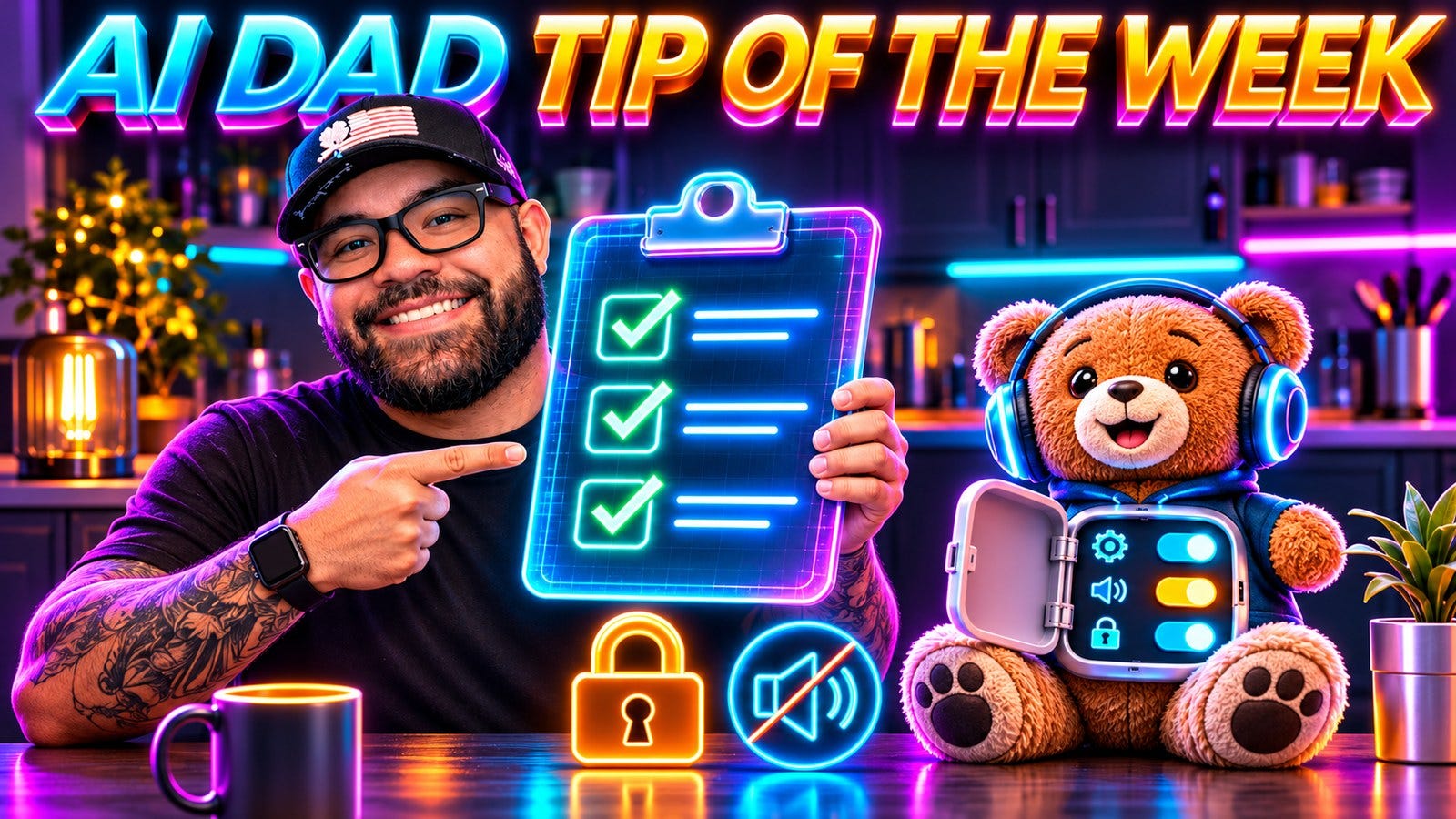
Unbox it before they do:
If an AI toy is on your gift list, look up which chatbot it uses and whether it has a real push-to-talk button you have to hold down.
Play with it yourself for at least an hour, not a quick 15 minutes, before you wrap it.
Plan for shared spaces, not the bedroom or bathroom, and turn it all the way off. Saying “goodbye” may only put some toys to sleep.
Search the privacy policy for “data” and “personal information.” Any mention of advertisers receiving your child’s data is a red flag. Check whether you can turn the toy off remotely, and whether it can flag a concerning topic.
Those steps come from PIRG’s AI-toy tips in the same Nov 17 report that tested seven toys. The useful part for your house is simple: do not let the first long conversation happen under the tree.
Source: publicinterestnetwork.org
💙 If you or someone you know is struggling or in crisis, call or text 988 or chat at 988lifeline.org (Suicide & Crisis Lifeline, U.S.), any time.
That’s a wrap for Issue #32.
Hit reply and tell me: Have you tested an AI toy that’s on your gift list? And has your school said what its filters cover, and who gets the alerts?
I read every reply.
Until next week: work smarter, rest harder, spend time with the people who matter most.
Founder, aiskool.tech